
An old centre with rules of its own
Much of the centre falls within a heritage protection zone, which restricts façade colours, tile types and window frames. Working here means finding out what is and is not allowed before the first hammer blow.
In Loulé we do a great deal of refurbishment in the historic centre, and that brings constraints that do not exist on an estate: streets no lorry can enter, material carried up by hand, and heritage protection rules limiting what can be altered on the façade and the roof.
We get there the same day · Free site visit and quote
Loulé is our base. It is the town where our office is, where the equipment is kept, and where we know the streets well enough to know where a scaffolding van can park without getting in anybody's way.
The town grows between the old quarter at its centre and the newer housing on the edges, with the barrocal — the limestone hill country — rising to the north and the plain dropping away towards the coast. Two worlds sit side by side here: flats and houses from the eighties and nineties in the newer parts, and old buildings with thick walls, barrel tiles and worked parapets in the historic centre.
In Loulé we get everything: from the landlord who needs a flat repainted between tenants to the full refurbishment of a family home in the centre.
Much of the centre falls within a heritage protection zone, which restricts façade colours, tile types and window frames. Working here means finding out what is and is not allowed before the first hammer blow.
No lorry fits down the streets of the centre and there is no room for a cherry picker. A lot of what we do there involves carrying material up by hand and putting up narrow façade scaffolding.
Stone masonry walls built without a damp-proof course draw moisture up from the ground. Painting over it without dealing with the source gives you blisters within months.
We measure, see what is possible and listen to what you want the space to do.
Broken down by stage and by material, so you know exactly what you are paying for.
Dates per stage and coordination of the trades, settled before we start.
One person as your point of contact, with photographs of progress if you cannot be there.
A walk-through with you, correction of anything that needs it, and the post-construction clean included.
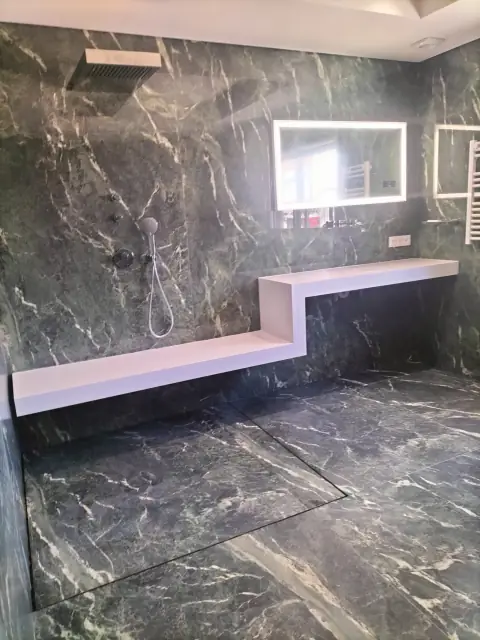
A complete bathroom refurbishment, from brickwork to stone: a walk-in shower, a floating counter and green marble from floor to ceiling.
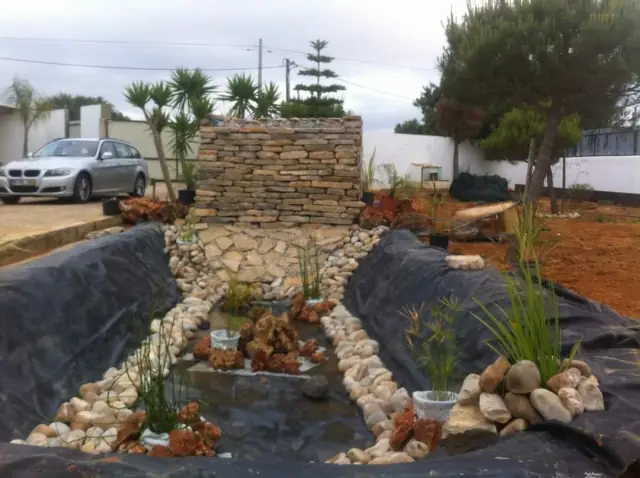
A garden pond with a stone cascade wall, aquatic planting and an edge in stone and pebble.
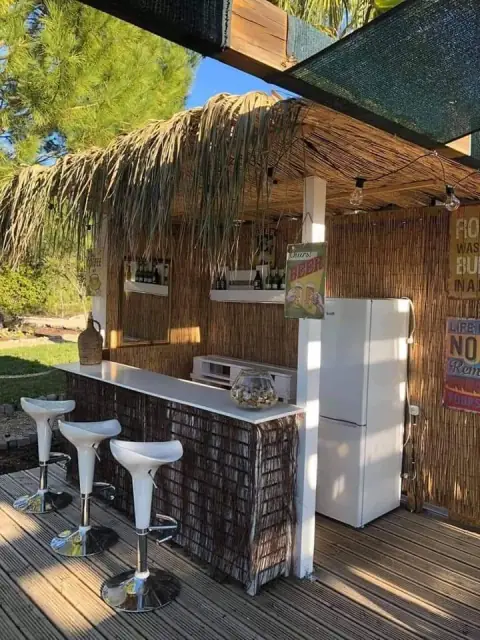
An outdoor bar built over decking, with a counter, a cane front and a thatched roof.
Loulé is our base — it is where our office and equipment are. We get there the same day and we know the town in detail.
Much of the centre falls within a heritage protection zone, which restricts façade colours, tile types and window frames. Working here means finding out what is and is not allowed before the first hammer blow. It is the situation we come across most often in Loulé, and it is why we look at the job before quoting.
Between two and four weeks, depending on whether the pipework changes. Most of that time is drying: tanking and tile adhesives have curing times that cannot be shortened without compromising the work.
For interior work with no structural alteration no permit is needed, only notification in some cases. Where a design or council licensing is required, we advise you and work with professionals who handle it.
For localised work, yes. For a refurbishment of the only bathroom in the house it is possible but uncomfortable — we usually say frankly when we think it is worth moving out for a few weeks.
Tell us what you need and we will come and look. We get there the same day and the visit is free.