An old centre with rules of its own
Much of the centre falls within a heritage protection zone, which restricts façade colours, tile types and window frames. Working here means finding out what is and is not allowed before the first hammer blow.
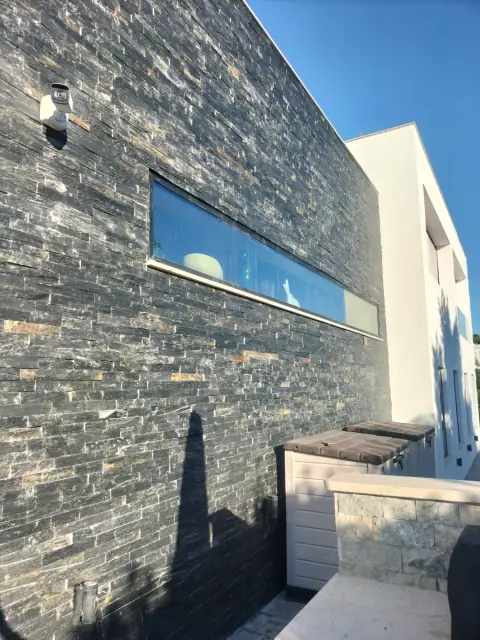
In Loulé we work stone in two different settings: masonry and detailing on the old buildings of the centre, where you have to follow what is already there, and boundary walls and cladding on houses in the outlying areas, where there is freedom of design.
We get there the same day · Free site visit and quote
Loulé is our base. It is the town where our office is, where the equipment is kept, and where we know the streets well enough to know where a scaffolding van can park without getting in anybody's way.
The town grows between the old quarter at its centre and the newer housing on the edges, with the barrocal — the limestone hill country — rising to the north and the plain dropping away towards the coast. Two worlds sit side by side here: flats and houses from the eighties and nineties in the newer parts, and old buildings with thick walls, barrel tiles and worked parapets in the historic centre.
In Loulé we get everything: from the landlord who needs a flat repainted between tenants to the full refurbishment of a family home in the centre.
Much of the centre falls within a heritage protection zone, which restricts façade colours, tile types and window frames. Working here means finding out what is and is not allowed before the first hammer blow.
No lorry fits down the streets of the centre and there is no room for a cherry picker. A lot of what we do there involves carrying material up by hand and putting up narrow façade scaffolding.
Stone masonry walls built without a damp-proof course draw moisture up from the ground. Painting over it without dealing with the source gives you blisters within months.
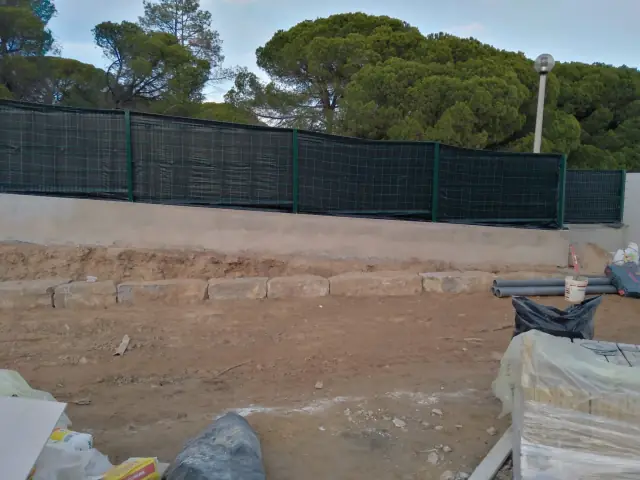
With walls, what decides everything is the slope, the soil type and where the water runs.
We show samples and, wherever possible, finished work — stone in a catalogue photograph is never stone on a wall.
The invisible stage, and the one that determines whether the wall lasts decades or years.
Laying with tones distributed, joints filled and the face cleaned down at the end.
Loulé is our base — it is where our office and equipment are. We get there the same day and we know the town in detail.
Much of the centre falls within a heritage protection zone, which restricts façade colours, tile types and window frames. Working here means finding out what is and is not allowed before the first hammer blow. It is the situation we come across most often in Loulé, and it is why we look at the job before quoting.
It is not compulsory, but a colourless water repellent greatly reduces the white efflorescence and the green growth on faces that get little sun. It is repeated after a few years.
Veneer is a thin sheet bonded to the substrate, cheaper and quicker, but with little thickness at corners and junctions. Natural stone laid with real thickness gives genuine depth to the joints and the corners — you notice it most at the arrises.
We do; it is the traditional technique of the barrocal and the most suitable for terracing. It takes longer to build because every stone has to fit against its neighbours, and that is reflected in the quote.
Tell us what you need and we will come and look. We get there the same day and the visit is free.