
Natural Stone and Walls in the Algarve
Natural stone cladding and walls built to last, with drainage done properly.
Working natural stone is one of the few things in building where there is nowhere to hide. A badly laid schist wall shows from a distance: irregular joints, poorly distributed tones, pieces repeating the same pattern every half metre. Laid well, a stone façade is the finish that ages best in the Algarve.,We do façade cladding in schist and local stone, retaining and boundary walls, terracing, outdoor steps and masonry. On retaining walls, the part nobody sees is the part that matters: the drain, the gravel and the membrane behind it. A handsome wall without drainage falls down — it is only a question of how many winters.
What's included
- Façade cladding — Schist, local stone and irregular stone laid with a considered distribution of tones and formats.
- Retaining walls — Sized foundation, drain, gravel and drainage membrane behind — built to hold back earth, not just to look right.
- Boundary and dividing walls — In dressed stone or dry stone, finished with a coping or an upright capping course.
- Terracing and embankments — Restoring old terrace walls and building new ones on sloping ground.
- Outdoor steps and paving — Solid stone steps, cobbling and flagstones.
- Stone cleaning and treatment — Removal of efflorescence and green growth and application of a water repellent, with the right product for each type of stone.
How we work
-
1
Looking at the ground
With walls, what decides everything is the slope, the soil type and where the water runs.
-
2
Choosing the stone
We show samples and, wherever possible, finished work — stone in a catalogue photograph is never stone on a wall.
-
3
Foundation and drainage
The invisible stage, and the one that determines whether the wall lasts decades or years.
-
4
Laying and finishing
Laying with tones distributed, joints filled and the face cleaned down at the end.
Work we have done
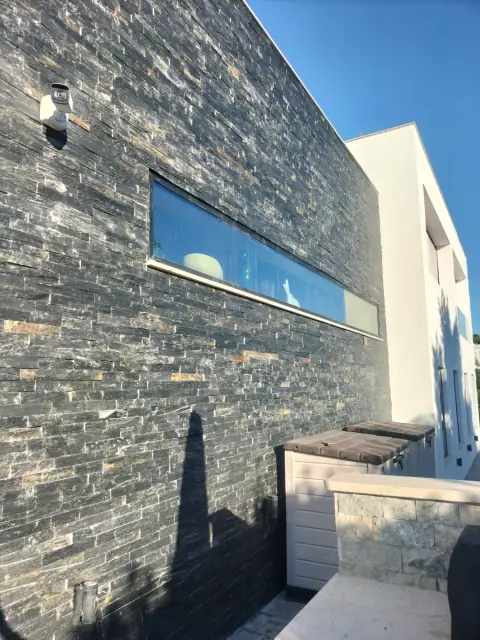
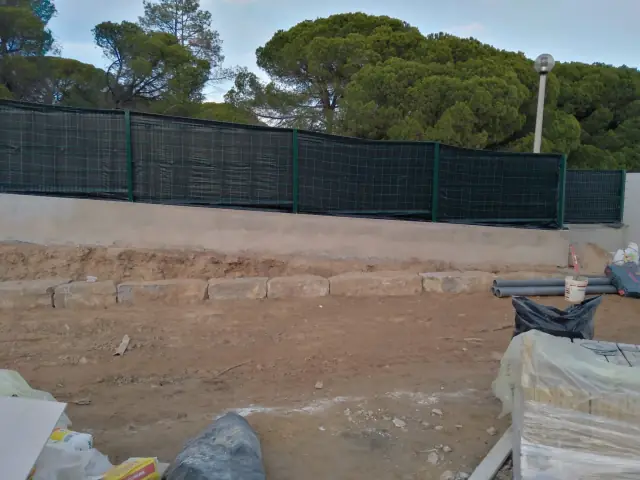
Real jobs, photographed by us.
Natural Stone and Walls in your area
Every area has its own building stock and its own problems. See what we do where you live.
Natural Stone and Walls in Santa Bárbara
Santa Bárbara de Nexe is villa country with a view — halfway up the slope between Faro and the barrocal, where a lot of people built the house they intend to stay in.
Natural Stone and Walls in Boliqueime
Boliqueime is barrocal country: houses scattered across hillsides, smallholdings with almond and carob trees, and a lot of old building stock that has never been properly touched.
Natural Stone and Walls in Almancil
Almancil and the golden triangle stretching out to Vale do Lobo and Quinta do Lago is the most demanding place we work — and, for that very reason, the one that keeps our finishing standards where they need to be.
Natural Stone and Walls in Loulé
Loulé is our base.
Natural Stone and Walls in São Brás
São Brás is the gateway to the hills: higher, cooler and wetter than the coast — and it is that difference in climate that defines the kind of work we do there.
Frequently asked questions
Why is my wall bulging?
Almost always for want of drainage. Rainwater builds up behind the wall and the pressure pushes it outwards. Rebuilding with a drain and gravel solves it; filling the crack with cement only delays the collapse.
Does schist need treating?
It is not compulsory, but a colourless water repellent greatly reduces the white efflorescence and the green growth on faces that get little sun. It is repeated after a few years.
What is the difference between natural stone and stone veneer?
Veneer is a thin sheet bonded to the substrate, cheaper and quicker, but with little thickness at corners and junctions. Natural stone laid with real thickness gives genuine depth to the joints and the corners — you notice it most at the arrises.
Do you build dry stone walls, without mortar?
We do; it is the traditional technique of the barrocal and the most suitable for terracing. It takes longer to build because every stone has to fit against its neighbours, and that is reflected in the quote.
How much does a stone wall cost?
It is priced by square metre of visible face, and what changes it most is the type of stone, the height of the wall and whether it is a retaining or a boundary wall. A retaining wall needs a foundation and drainage that a boundary wall does not.
How long does it take?
Stonework is slow by nature, because every piece is laid by hand and chosen for its place. A boundary wall of a few metres takes days; a retaining wall of any height takes weeks, counting the foundation and the curing time.
Where do you source the stone?
We work with suppliers in the region. We show samples and, wherever possible, work already done — stone in a catalogue photograph is never stone on a wall at real scale and in real light.
Can stone be applied over an existing wall?
It can, provided the substrate is sound and will take the weight. We check that first: stone laid over render that is already coming away ends up on the ground, and the cost of redoing it is far higher than treating the substrate at the outset.
Need natural stone and walls?
We will come and look and give you an itemised quote, with no obligation.